
In this post we cover how ratio utility billing systems (RUBS) divide utility costs across multi-familiy units, and what property owners and managers need to know.
What is RUBS?
RUBS stands for "ratio utility billing system." It's a system where landlords or property managers divide up the total cost of utilities across all the units in a property, according to a preset formula.
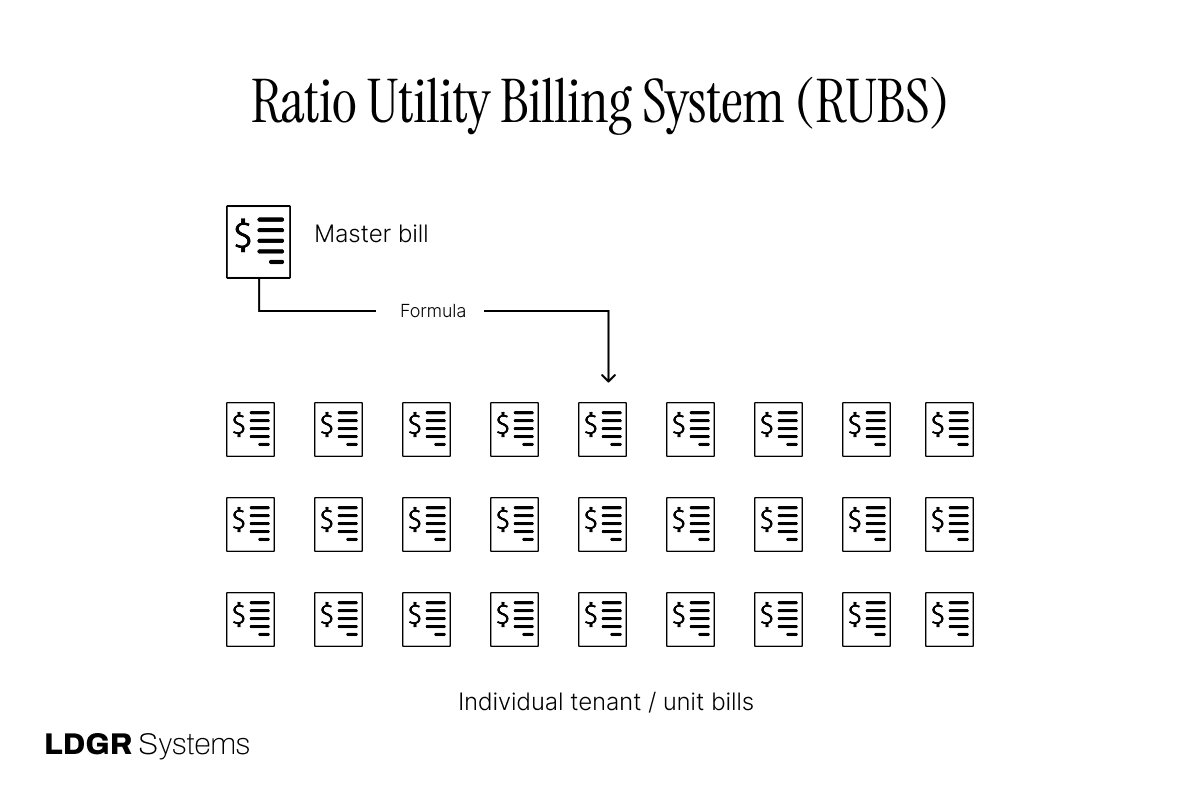
That formula can depend on factors like each unit's square footage or the number of bedrooms the unit has. The idea is to make sure that the formula is fair, transparent, and easy to understand. RUBS doesn't measure each unit's cost independently. Instead, it divides up a total cost across all occupied units.
After the utility bill has been determined for each unit, the landlord or property manager then bills each tenant for their costs separately.
How a ratio utility billing system works
A typical monthly workflow is straightforward. The property receives utility invoices, identifies the recoverable amount, applies the allocation formula, posts resident charges, and reconciles everything back to accounting records.
For example, a property might allocate water and sewer with a blended formula: 50% by occupancy and 50% by square footage. A larger unit with more occupants receives a higher share than a smaller one with fewer occupants.
The important part is repeatability. Whatever formula you choose should be disclosed in the lease, applied consistently each cycle, and supported by a clean audit trail.
Why RUBS matters
Utility billing is one of the biggest operational challenges for multi-family property managers and owner-operators, but understanding how billing works, as well as the pros and cons of it, can help landlords operate more efficiently.
RUBS is an alternative to "sub-metering," or where every unit in a multi-family property has its own meter. If these meters haven't been installed, then RUBS can provide a method for property managers to land on a fair estimate of each tenant's usage.
In addition to saving money on installing sub-meters, RUBS can also simplify the billing process, since there don't need to be as money utility accounts.
RUBS multifamily example with numbers
Assume a 20-unit building receives an $2,000 master water/sewer invoice.
The building has ten identical units, and in theory, each unit should be charged $100 monthly.
But now imagine that some units are larger than others, or that the landlord charges an additional monthly fee for billing services.
In that case, the monthly bill for each unit might be slightly higher or lower than $100.
The exact amount will vary by property policy. What matters is that every resident charge traces back to one recoverable pool and one documented formula, and that landlords have a central source of truth for all calculations and bills.
Where RUBS works well
RUBS works best in properties where master-meter utility setups make submetering impractical or expensive in the near term. In these cases, operators can recover a meaningful share of utility expense that would otherwise erode NOI.
It also works better when communication is clear. When residents understand the billing method before move-in and statements are transparent, disputes are usually lower.
RUBS does not work well when execution is sloppy. Outdated occupancy data, inconsistent vacant unit treatment, or unclear lease language quickly create billing friction and collection problems.
Compliance and operating controls to set first
Before launching or updating RUBS, align legal, operations, and accounting. Start with lease language and local requirements. Jurisdictional rules can affect what is recoverable and how disclosures must be presented.
Then tighten your data inputs. Occupancy records, move dates, and unit attributes directly affect charge accuracy. Bad source data leads to bad resident billing, even with good software.
Finally, require monthly reconciliation discipline. Your team should be able to show, for any charge, which invoice period it came from, which formula was used, and how it posted to accounts receivable and the general ledger.
If your process cannot answer those questions quickly, you're carrying hidden risk.
How to decide if RUBS is right for your portfolio
Ask three practical questions.
First, is unrecovered utility expense material at your assets? Second, is submetering infeasible in the near term? Third, can your team run a policy-driven process with reliable data and monthly reconciliation?
If the answer is yes across all three, RUBS is usually a strong option. If not, fix the process foundation first. A ratio utility billing system improves outcomes only when the underlying workflow is controlled.
For teams evaluating tooling, integration depth matters. Utility billing should connect directly to your accounting workflow so charges, postings, and reconciliation stay in sync.
Why this matters for modern property managers
Utility billing sits where operations and accounting meet. When those systems are disconnected, small errors can compound and turn into big problems like shut-off notices or payment disputes.
RUBS can be an effective option for billing, but it requires quality data, clear policies, and a high attention to detail.
If you want to implement or improve RUBS multifamily billing without creating another back-office silo, LDGR can helps connect utility billing activity to your broader property accounting software stack. See how LDGR fits your workflow.
Ready to automate your property accounting?
See how LDGR can bring speed, reliability, and cost savings to your financial operations.
Schedule a free consultation